Here I’ll list the original ideas of the design, things will evolve on the real thing depending how various tests goes.
Requirements
This needs to be used for a skateboarding slalom stopwatch, so this means:
- a start trigger when riders goes by the first cone
- a stop trigger when riders goes by the last cone
- an accurate timing mechanism between the start and stop triggers
- should work for 40 cones with possible spacing of 5, 6 or 7 feet
- have a convenient way to check time after a run
That’s the basic of any stopwatch that could be used for slalom skateboarding.
Basic features
The minimum feature set that is mandatory for this project to make sense:
- Wireless
- Battery powered
- Small foot print for ease of transportation
Additionnal features wishlist
This is the ideal feature list I wanted at first, note that I already know some of these things won’t be possible at the time I’m writing this, but I’ll still list them here.
- Rider detection
- Webserver on one of the devices so you can check your time, time history, etc
- Configurable spacing and number of cones to estimate average speed
- Speed at start and speed at stop measurement (note: impossible with ultrasonic sensors)
- Configurable trigger distance
- 2 lane racing with beep, remote controlled via wifi
- Cone spacing measurement helper
Implementation idea
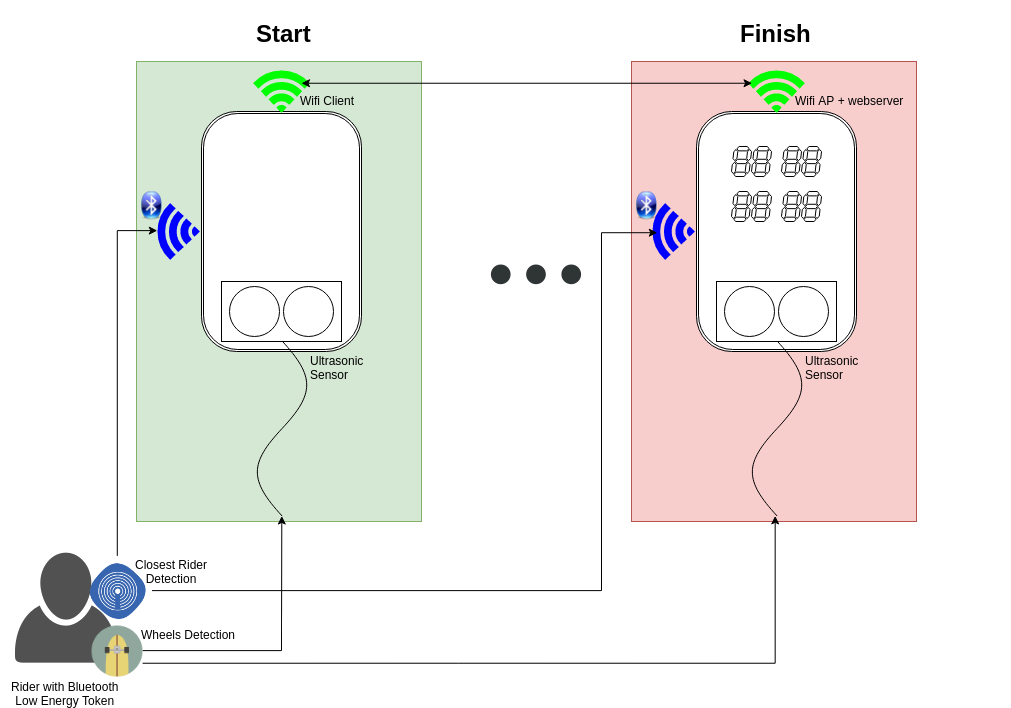
Parts and Features
So my thinking behind this would be to use two ESP32 devices:
Host
- ultrasonic distance sensor for stop trigger.
- rider detection
- WiFi AP
-
Webserver with:
- configuration: number of cones, spacing
- mode selection (maybe also available with button and LED ?)
- Rider token registeration
- time history, with average speed
- allow to note number of pushed/hitted cones with a customisable penalty
- screen to display time and time record
- a way to upload times to an online service, with maybe some kind of ranking
Client
- ultrasonic distance sensor for start trigger.
- rider detection
- send of trigger to Host as timing will be done there
Rider token
It should be a bluetooth low energy (BLE) beacon, advertising and power of reception should be use to identify closer beacon and choose which rider lilkely triggered the device.
One racer scenario description
This describe how things should happen according to my current plan for one racer going through the course.
- The rider gets started
- Rider goes by the first cone and the Client device, so ultrasonic sensors detects a range below its trigger
- Client device send a start signal to the Host via WiFi
- Host receive the signal and start a timer right away
-
Client tries to detect the rider via BLE scanning
- if a token is close enough, send its ID to Host
- if no token is close enough to make sense, send a cancel to Host
- Rider goes through the course, and arrives to the end
- Host trigger see the riders passing by, and stops its timer
-
Host then:
- Update history with new time for the rider, and the average speed
- display the time
- make the new history available to the webserver
And that should be it, of course there will be a lot more to it with configuration


